Music spreads all over the stage and, with the rising light

brings forth human figures that appear as holograms

The Company

For more information contacts us at production@danceathens.gr

Dance Athens is a contemporary dance company based in Greece, with an international network of productions and collaborations.

Acting as a non-profit organisation dedicated to advancing and promoting the art of dance, it organises and supports various activities around dance that include among others: professional contemporary dance performances, educative workshops, creative projects combining the arts, dance vacation and student exchange programmes.

Under its artistic director and main choreographer Ilias Bageorgos it creates and produces original dance performances, that have been honoured by UNESCO and supported by the Greek ministry of Culture, and performed across Europe.

Combining production with educational programs and creative workshops and residencies, the organisation has cemented a vast network of collaborating organisations and peers including institutions such as PARTS (Brussels), Graham for Europe, Peridance School of New York, Martha Graham School of dance, IFunamboli, Gaga Movement language, National Opera Stara Zagora, Company Rau and more. Among its collaborators are included artists such as Russell Maliphant, Rakesh Sukesh, Korhan Basaran, Dana Fouras, Antonia Foniadakie and many more.

With full dedication to its creative purpose and the high quality of its productions, the company is now touring its current dance production “STRATA” across Europe and preparing its next big and interdisciplinary dance production.

Gallery

Eros & Psyche

Έρως & Ψυχή

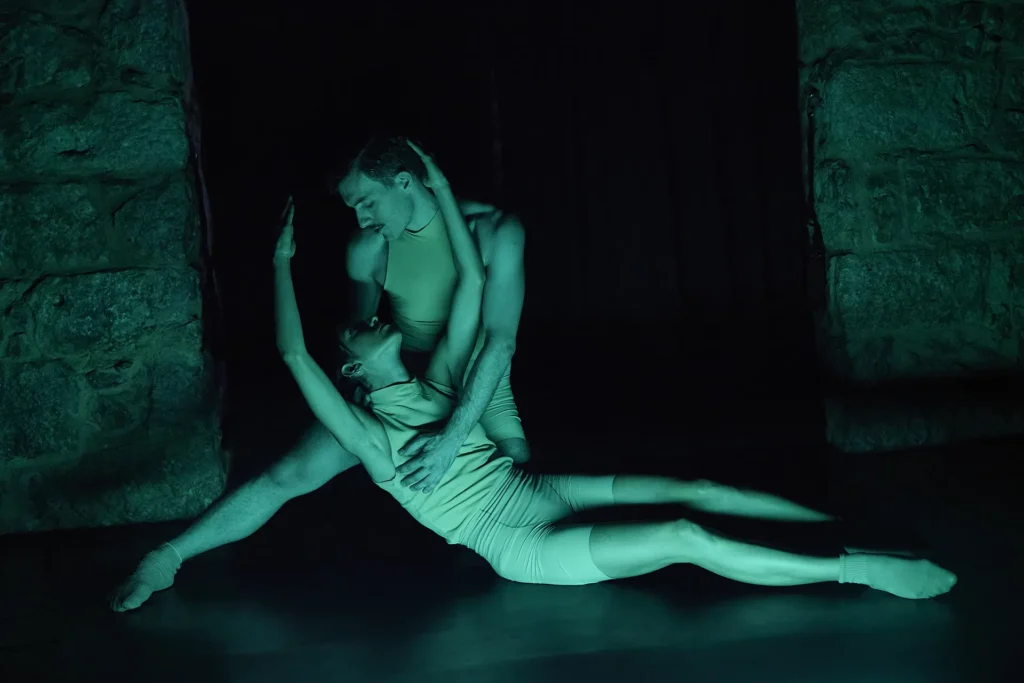
The encounter between the soul and Eros draws us into a physical journey — both internal and tangible — toward the approach of the “other.”

The choreographic proposal is inspired by the ancient myth of Eros and Psyche, as recorded by Apuleius in Roman times, and as poetically rendered by Irish poet Mary Tighe in her 19th-century work “Psyche, or the Legend of Love.” The myth tells the story of Eros and Psyche, two mythic figures personifying their respective concepts, and of their struggle to define their own life and love. The choreographic approach unfolds as a duet, where the duality of the mythic figures — as well as the roles of lover and beloved — intertwine, forming a unified system of two moving bodies.

The choreography focuses on the transformative process implied by love, in which trials and pleasures merge into a single embodied experience. This experience is inseparably linked to the physical presence and materiality of the bodies, yet it also exists beyond the limits they impose — even beyond the perception of the self.

Pain, as approached in Buddhist philosophy, is connected to the core of human existence, serving as proof that we are alive. In this way, it assumes a central role in the consciousness of both the “self” and the “other.” Through love — and the motivation it provides for emotional action and for turning desire into reality — pain emerges not as a negative byproduct but as a certainty, which in turn affirms and strengthens love itself. As seen in the ancient myth, during Psyche’s second trial, facing pain with patience and tenderness integrates the concept of love into the experience of suffering and eliminates the tendency toward violence.

Dance, as a performing art, is inherently connected to the trial of the body — to physical strain and endurance. A “dancing body” is constantly tested, carrying within it the effort and complexity of a creative process. The artistic “product” does not simply emerge as a result; it exists within the process itself. Based on this perspective, the experience of a body under restriction — striving for liberation not against but through coexistence with its trial — becomes the primary choreographic material. Through the body’s physical presence, the roles of subject and object of love blur, creating a kinetic fusion that serves as a bridge toward the “other.”

In a contemporary era where personal contact is increasingly filtered through screens, the fear of communication and rejection intensifies. Love, as a bold trial and an act of rebellion against the ordinary, stands against fear and superficial interaction, creating the impetus for a personal journey of transformation. In this way, it becomes the field where the “impossible” and the “ideal” may be realized.

Technical Details
Estimated Duration: 10’

Credits
Choreography: Ilias Bageorgos
Costume Design: Francesco Infante
Production Management: Dance Athens
Performance: Kostis Papadopoulos, Evi Kitrinou

Alico

Alico

Strata

An endless journey — a road leading to the edge of yourself.

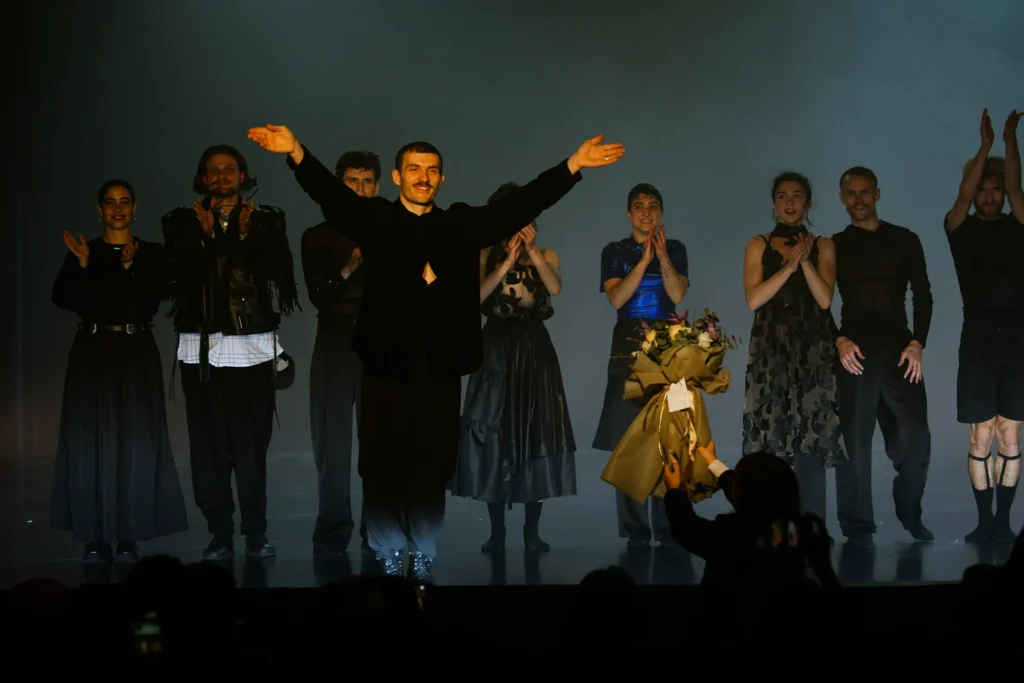
The new contemporary dance production STRATA, by choreographer Ilias Bageorgos and the company DANCE Athens, was presented on March 2, 3 and 4 at Anna & Maria Kalouta Theatre.

Six bodies on stage follow their own deeply personal journeys. They dive into a fluid universe of images and memories, where the imaginary and the real merge. Through this inner passage, they are challenged and transformed, playing with the limits of their identities.

STRATA is a collaboration between the arts of dance, music, and visual thinking. With an international dance cast on stage and a team of distinguished artists behind its creation, the performance narrates a story so personal that it reaches the roots of our collective identity. Through the moving bodies, it addresses issues of social roles, gender, and identity, opening a dialogue of questions and reflections — speaking in the immediate and poetic language of movement.

Credits
Choreography & Direction: Ilias Bageorgos
Music Composition: Manos Antoniadis
Dramaturgical Consultant: Bettina Panagiotara
Costume Design: Francesco Infante
Lighting Design: Skarlatos Vasilopoulos
Rehearsal Assistant: Maria Manoukian
Performance Photography: Mike Chatzigiannis

Performed by:
Sebastian Kapps, Theo Samsworth, Konstantinos Argyriou Evangeloudis, Evini Pantelaki, Melina Sofokleous, Iliana Yfantí

Production Management & Execution: DANCE Athens

STRATA was realized with the financial support of the Hellenic Ministry of Culture.

Media Sponsors: ERT, Third Programme 90.9, Kosmos 93.6

I Am Giallo

I Am Giallo

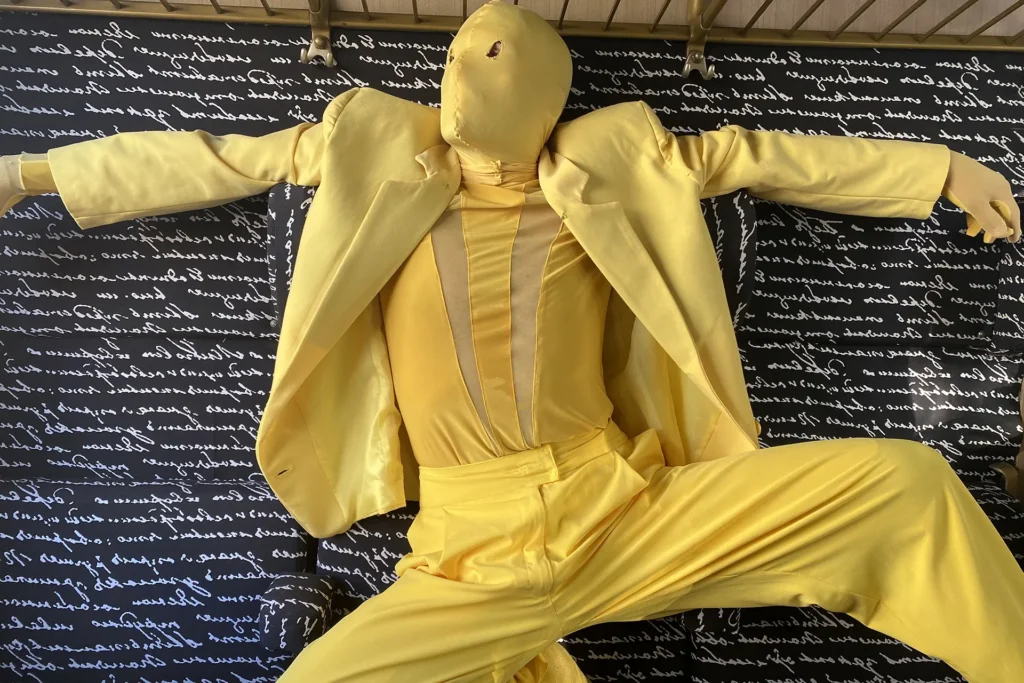
Light, sun, glow, beginning, joy, party, let’s go — GIALLO! A solo dance performance that explores the boundaries of the GIALLO identity.

“Giallo” means “yellow” in Italian, and through choreography, the color yellow gains material substance and comes alive through movement — as mood, as identity, as dance. Beyond the color itself, the term “giallo” is also used to describe a genre of novels and films that combine mystery and horror. These are stories that bring danger, action, eroticism, and instinct to the forefront.

Exploring the connection between these more “wild” components of human existence and the joyful, optimistic aspect of the color yellow, the dancing body is called to transcend the limits of its everyday identity, opening itself to movements and flows guided by instinct.

The original music of the performance is inspired by the work of director and musician Dario Argento, the leading representative of giallo films. Through his creations, he explored the coexistence of classical musical lines with animal voices and the sounds of everyday actions and objects. Following this path, the music of the performance creates a sonic environment for movement that keeps the senses alert and heightened.

Pure, unfiltered color becomes the protagonist, echoing the words of the Fauvist painters:
“How do you see these trees? They are yellow. So, put in yellow; this shadow, rather blue, paint it with pure ultramarine; these red leaves? Put in vermilion.”
The term Fauvism derives from the French word fauve, meaning “wild beast.” True to this name, the Fauvist artists approached the world and art through the lens of absolute, powerful color, combined with free and instinctive brushwork. In the same spirit, the dancing body moves with boldness and expressiveness, drawing from contrasting styles and seeking the truth of movement through its most extreme manifestations.

The choreography is a process of transformation and transcendence of everyday life, aiming to carry us away from the grey and mundane world toward a groovy, luminous, daring GIALLO reality — unapologetically yellow.

The work remains a work in progress, having been partially presented in its early stages at the 8th Rhodes Dance Festival and the 5th Contemporary Dance Festival at Rouf (August & September 2022).

Credits
Concept, Choreography & Performance: Ilias Bageorgos
Costume Design & Construction: Francesco Infante
Original Music Composition: Stefanos Giakoumakis
Lighting Design: Skarlatos Poulos-Vasilopoulos

The Visitor

HYDRA 1919. “Nothing touches the poet, not even time. For within him coexist the childlike, the elderly, and the demonic,” writes Miltos Sachtouris.

“Miltos Sachtouris does not belong to this world or the other. He is a visitor. Only his mother knows that it was not a birth, but a visitation,” wrote Giorgos Kakoulidis.

“I Lived Close” (In memory of Giorgos Makris)

I lived close to living people
and I loved living people
yet my heart was closer
to the wild sick ones with wings
to the great limitless madmen
and even to the wonderfully dead.

Choreography: Ilias Bageorgos
Performance: Konstantinos Argyriou Evangeloudis
Concept & Music Curation: Aristeidis Bageorgos
Costume Designer: Francesco Infante
Video Artist: Stelios Karachalios

Compartments Dance Festival 2019
Theatre Train to Rouf (To Treno sto Rouf)

The Only Journey of His Life

A story inspired by the short tale by G. Vizyinos, “The Only Journey of His Life.”

A fairy tale that portrays the entirety of human life. A surrealism that reflects folk tradition, drawn from the grandfather’s myths, delivered with the simple mastery of a child’s mind and the sensitivity of the writer.

The discord between gender and social image, the different social conditions and human temperaments, ultimately have—depending on the era—their own Justice, their own Morality, and inevitably their own Psychology. Today, dressing a boy in girls’ clothes is considered repulsive; two hundred years ago, it was life-saving.

Just as, in Byzantium, parents would castrate their children to secure future access to positions at court. A harsh reality, coupled with an intense longing for travel. In the end, we understand that the journey begins with the desire to travel.